
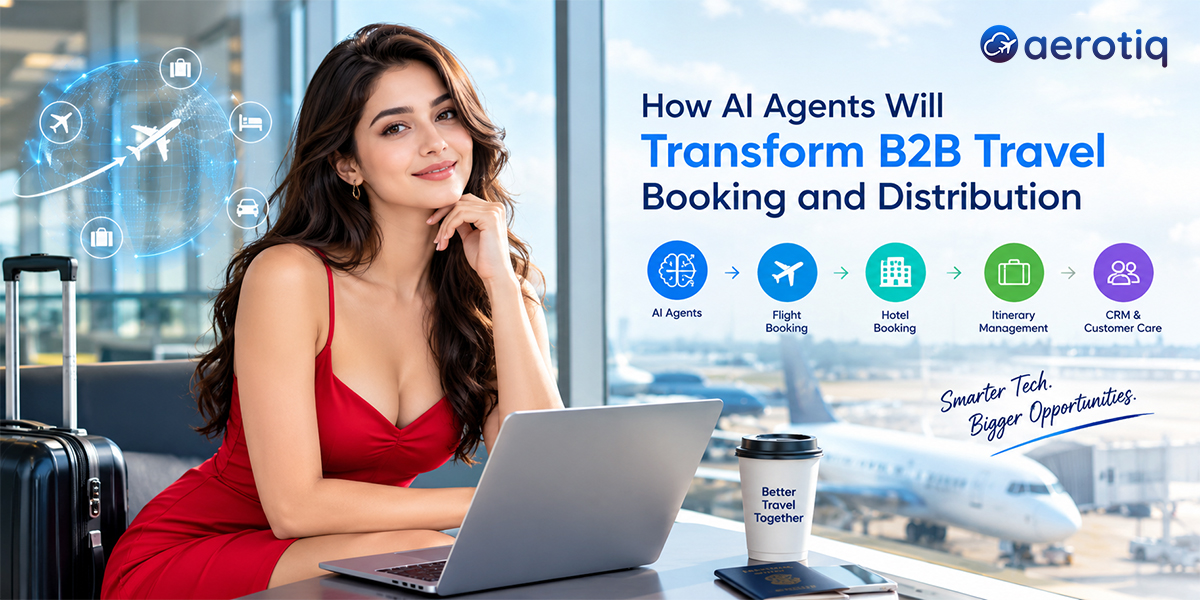
The B2B travel industry is entering a new phase of digital transformation. Travel agencies, tour operators, consolidators, corporate travel companies and online travel businesses increasingly need faster access to inventory, better pricing, automated workflows and personalized customer service.
The next major shift is agentic AI - AI systems that can understand a goal, analyze information, use connected tools, and complete multi-step tasks with limited human intervention.
In travel, this means moving beyond AI chatbots that simply answer questions. AI agents can potentially search, compare, recommend, create itineraries, check availability, manage bookings, and support post-booking operations.
According to IDC, agentic AI is expected to increasingly influence discovery, comparison, booking and travel service workflows in 2026.
For B2B travel businesses, platforms such as Aerotiq can provide the technology infrastructure needed to connect AI capabilities with travel booking and distribution workflows.
What Are AI Agents in B2B Travel?
Traditional travel software generally requires users to perform individual steps.
For example:
1. Search flights
2. Compare fares
3. Check availability
4. Select an itinerary
5. Add passenger details
6. Check booking conditions
7. Complete the reservation
8. Send confirmation
An AI agent can change this workflow by understanding the overall objective.
A travel agent could enter:
“Find the most suitable return flight for four passengers traveling from Delhi to London next month, with one checked bag each, and keep the total fare within the customer's budget.”
Instead of simply displaying search results, an AI-powered workflow could evaluate multiple options against predefined business rules and customer preferences.
The human agent can then review and approve the recommended option.
This creates a shift from search-driven booking to goal-driven booking.
1. Faster Flight and Hotel Search
One of the biggest opportunities for AI agents is reducing the time required to search across travel inventory.
B2B travel companies often work with multiple airline connections, suppliers, hotel providers, GDS content, NDC content, and other sources.
IATA's NDC standard is designed to improve communication between airlines and travel sellers while providing access to richer air content and more transparent shopping experiences.
An AI agent can sit above these connected systems and help interpret the available information.
Instead of manually checking multiple options, agents could identify:
· Lowest available fares
· Flexible fare options
· Preferred airlines
· Baggage-inclusive options
· Corporate travel policies
· Preferred suppliers
· Connection times
· Ancillary services
· Hotel availability
· Customer-specific requirements
This can significantly simplify the booking workflow for B2B travel professionals.
2. Intelligent Fare Comparison
Price alone is rarely enough to determine the right travel product.
A slightly cheaper flight may have a longer connection, no baggage, restrictive cancellation conditions, or an inconvenient departure time.
AI agents can evaluate multiple attributes simultaneously.
For example, an agent could compare:
Option A: Lower price + long connection
Option B: Slightly higher price + shorter journey
Option C: Higher price + flexible cancellation + baggage
The system can then present the differences clearly to the travel professional.
This becomes particularly useful for agencies managing corporate travelers, where travel policies and traveler preferences can be incorporated into the search criteria.
3. Personalized B2B Travel Recommendations
Personalization is another major area where AI agents can change travel distribution.
A travel agency may already have information about a customer's previous bookings, preferred airlines, cabin preferences, hotel choices, and typical travel routes.
With appropriate permissions and data controls an AI agent could use this information to make more relevant recommendations.
For example:
“This customer usually selects morning departures, prefers a specific airline and books refundable fares for business trips.”
Instead of starting every search from scratch, the agent can incorporate these preferences into the workflow.
The result is a more contextual booking experience.
4. Automated Itinerary Creation
Creating itineraries can consume considerable time for travel professionals.
An AI agent can potentially combine flights, hotels, transfers, activities, and other travel services into a structured itinerary.
For example:
Day 1: Delhi → Dubai
Day 2: Dubai city tour
Day 3: Dubai → London
Day 4: London business meetings
The agent can organize information, identify scheduling conflicts, and prepare a customer-ready itinerary.
For B2B travel companies, this can reduce repetitive administrative work while allowing travel consultants to spend more time on customer relationships and sales.
5. Smarter Booking Automation
AI agents can also automate repetitive booking tasks.
A connected travel agent could potentially:
· Retrieve customer details
· Search inventory
· Compare options
· Apply business rules
· Select a preferred option
· Prepare booking information
· Generate an itinerary
· Trigger approval workflows
· Send booking information
The final transaction can remain subject to business rules and human approval where required.
This human-in-the-loop approach is particularly important for high-value or complex bookings.
6. AI-Powered Travel Agency CRM
The future of B2B travel technology is not just about booking engines.
CRM systems are also becoming more intelligent.
An AI agent connected to a travel CRM could help sales teams identify:
· New leads
· Follow-up opportunities
· Customers who have not booked recently
· Frequently requested destinations
· High-value customers
· Unanswered inquiries
· Upcoming travel requirements
For example, if a customer regularly travels between India and Europe, an AI system could identify relevant opportunities and help the sales team prepare a personalized proposal.
This turns CRM data into actionable business intelligence.
7. Improving NDC and Modern Airline Distribution
Airline distribution is moving toward more dynamic offers and orders.
IATA's Modern Airline Retailing framework includes NDC, Dynamic Offers, and ONE Order as important components of the industry's transition toward modern retailing.
Dynamic Offers can allow airlines to generate more relevant products and pricing based on shopping context and customer requirements.
AI agents can complement this ecosystem by helping B2B sellers interpret and act on richer content.
Instead of presenting travel professionals with large volumes of disconnected data, AI can help organize that information around the customer's actual requirement.
This could make modern airline content easier to use across B2B distribution channels.
8. AI Agents and Travel Operations
Booking is only one part of travel.
After a reservation is made, agencies often deal with:
· Schedule changes
· Cancellations
· Refund requests
· Rebooking
· Ticket changes
· Customer questions
· Hotel modifications
· Payment follow-ups
· Itinerary updates
AI agents can monitor workflows and identify actions that need attention.
For example:
“Flight schedule changed. Check alternative flights matching the customer's original requirements and prepare replacement options.”
Instead of requiring an employee to start the entire process manually, an AI agent can prepare the relevant information for review.
9. Aerotiq's Role in the AI-Powered B2B Travel Ecosystem
Aerotiq is positioned around the technology needs of travel agencies, consolidators, and enterprise travel businesses.
Its B2B travel technology ecosystem brings together capabilities such as airline and supplier connectivity, booking workflows, CRM, itinerary creation, hotels, cars, cruises, and travel management tools.
This type of connected infrastructure can provide the foundation on which AI-powered workflows operate.
The important point is that AI does not replace the underlying travel technology infrastructure.
Instead, AI can become an intelligent layer that works with booking systems, supplier connections, CRM data, inventory and business rules.
For a B2B travel company, this can create a more connected workflow from lead → search → recommendation → booking → servicing → customer relationship management.
10. What the Future of B2B Travel Booking Could Look Like
The traditional model looks like this:
Customer → Travel Agent → Booking System → Supplier
The emerging model could become:
Customer → AI Agent → B2B Travel Platform → Multiple Suppliers
The AI agent interprets the customer's requirements while the travel platform handles connectivity, inventory, pricing, booking, and operational workflows.
The travel professional remains an important part of the process, particularly for complex travel requirements, relationship management, exceptions, and final approval.
This combination can create a human + AI travel operation rather than a completely automated one.
Key Benefits for B2B Travel Companies
AI-agent adoption could help travel businesses improve several areas:
|
Area |
Potential Impact |
|
Search |
Faster discovery and comparison |
|
Booking |
Fewer repetitive manual steps |
|
CRM |
More intelligent lead and customer management |
|
Itinerary |
Faster itinerary creation |
|
Distribution |
Better use of rich supplier content |
|
Customer Service |
Faster response to routine requests |
|
Operations |
Automated monitoring and workflows |
|
Sales |
More personalized recommendations |
|
Productivity |
Employees spend more time on complex tasks |
The exact benefits will depend on data quality, integrations, business rules, supplier connectivity, and how much automation a company chooses to implement.
The Road Ahead for B2B Travel
AI agents are moving the travel industry from simple automation toward intelligent task execution.
The biggest opportunity for B2B travel businesses is not simply adding a chatbot to an existing website. It is building an interconnected technology environment where AI can understand customer requirements and work across booking, distribution, CRM, itinerary, and servicing systems.
As airline distribution continues evolving toward richer Offers & Orders models, the ability to process and act on increasingly complex travel content will become more important. IATA describes the industry's current phase as moving from vision toward implementation of modern airline retailing.
For travel agencies, consolidators, and enterprise travel companies, this creates an opportunity to rethink how booking operations are managed.
Aerotiq can be part of this transformation by combining B2B travel technology with AI-driven workflows, helping travel businesses move toward faster, smarter and more connected travel distribution.
The future of B2B travel booking is likely to be less about navigating multiple systems manually and more about giving intelligent agents the tools, data and rules they need to help travel professionals get the right job done.