
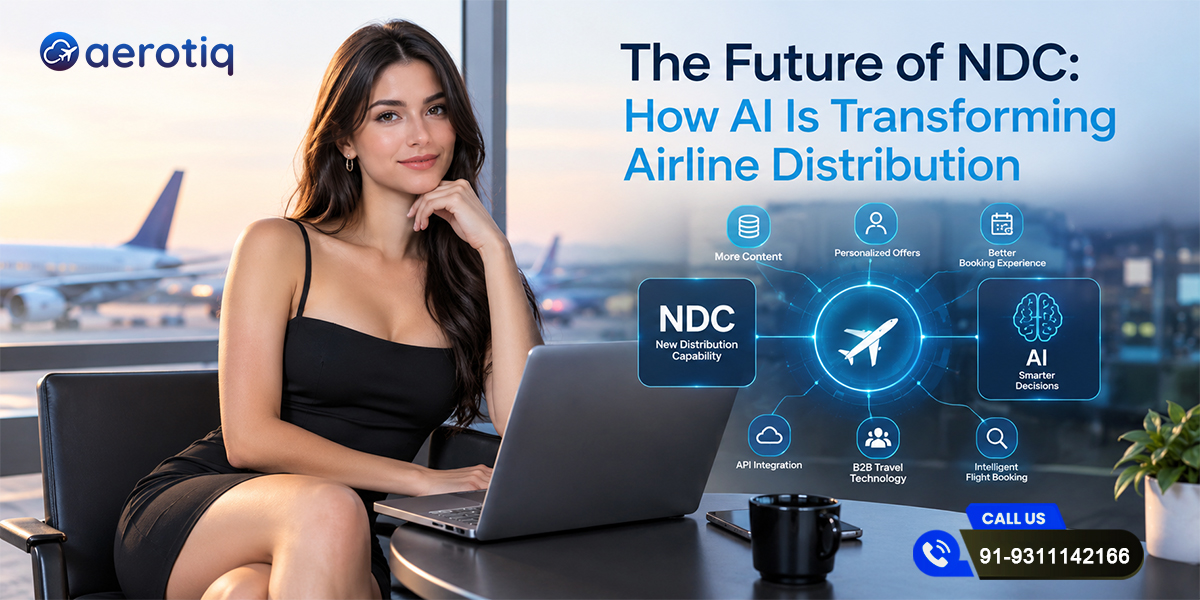
The airline industry is undergoing a major transformation in the way flights, fares, ancillaries, and travel products are distributed. Traditional distribution systems have played an important role in connecting airlines with travel agencies and other sellers, but the growing demand for richer content, personalization, automation, and faster booking is changing the landscape.
At the center of this transformation is NDC airline distribution, supported by modern APIs, automation, and artificial intelligence. The combination of NDC travel technology and AI is creating new opportunities for airlines, travel agencies, consolidators, online travel companies, and corporate travel businesses.
For B2B travel platforms such as Aerotiq, this shift represents an opportunity to create smarter, faster, and more connected travel booking experiences.
What Is NDC and Why Does It Matter?
NDC stands for New Distribution Capability, an airline distribution standard developed by the International Air Transport Association (IATA). It enables airlines to distribute richer and more detailed content through modern technology and APIs.
Traditional airline distribution can make it difficult to display the full range of products and services offered by an airline. NDC can provide access to information such as:
· Branded fares
· Checked baggage
· Seat selection
· Meals
· Priority services
· Upgrades
· Flexible fare options
· Other ancillary products
This makes NDC an important part of modern airline distribution technology.
Instead of presenting travelers with only a basic flight and fare, airlines can provide a more complete product offering. Travel sellers can then use this information to create better booking experiences.
How AI Is Changing Airline Distribution
While NDC provides richer airline content, artificial intelligence can help travel businesses understand and use that content more effectively.
AI in airline distribution can analyze large volumes of information, including fares, schedules, availability, fare conditions, customer requirements, and ancillary products.
For example, a traveler may want the cheapest flight but also require checked baggage and a flexible cancellation policy. A conventional search engine may require the traveler to manually compare several options.
An AI-powered system can understand these requirements and help identify the most suitable options.
This is where AI travel technology can make a significant difference to the travel industry.
NDC Travel Technology and AI-Powered Booking
Modern NDC travel technology allows airlines and travel businesses to exchange richer product information through API-based systems.
When this technology is combined with AI, travel platforms can build more intelligent booking workflows.
An AI-powered travel booking platform can potentially:
· Understand natural-language travel requests
· Compare airline offers
· Analyze fare conditions
· Identify suitable flight options
· Recommend relevant ancillaries
· Build itineraries
· Support booking workflows
· Automate repetitive tasks
This can help travel professionals spend less time searching through multiple systems and more time serving customers.
The Role of Airline API Integration
Modern travel distribution depends heavily on connectivity. Airline API integration enables travel technology platforms to connect with airline systems and access information required for flight shopping and booking.
NDC APIs can provide access to richer airline offers, while other APIs and technology systems may provide additional inventory and services.
For a B2B travel platform, managing these integrations efficiently is essential. A robust technology layer can help normalize different sources of content and present information through a unified interface.
This can make the booking process easier for travel agencies, consolidators, and corporate travel teams.
How NDC Can Improve B2B Flight Booking
The growth of B2B flight booking is closely connected to the evolution of airline distribution.
Travel agencies and corporate travel companies need access to accurate fares, schedules, availability, fare rules, and ancillary products. They also need efficient tools for managing bookings and customers.
NDC can help B2B travel businesses access more detailed airline content. Combined with AI, this information can be analyzed and organized according to specific customer requirements.
For example, an agency could search for flights based on budget, baggage requirements, preferred airlines, travel dates, flexibility, and schedule preferences.
An intelligent system could then help rank the available options according to those requirements.
AI Travel Agents and the Future of Booking
One of the most interesting developments in the travel industry is the emergence of AI travel agents.
Traditional travel technology generally requires users to search, filter, compare, and select flights manually. AI agents could change this interaction by allowing travelers or travel professionals to communicate their requirements in natural language.
For example:
"Find a business-class flight from Delhi to Singapore next Monday, with one checked bag, a flexible fare, and a convenient evening departure."
An AI travel agent could interpret the request, access available airline content, compare relevant offers, and present suitable options.
As airline content becomes increasingly accessible through NDC and APIs, AI agents could become a powerful interface between travelers and travel inventory.
Intelligent Flight Booking for Travel Businesses
The future of intelligent flight booking is not simply about finding the lowest fare.
Travelers often need to consider the total value of a flight, including baggage, flexibility, seat selection, schedule, connection time, and other services.
AI can evaluate multiple factors simultaneously and help present options based on the traveler's priorities.
For B2B travel companies, intelligent booking can also support sales teams by reducing repetitive searches and helping agents respond to customer requests more quickly.
This can be particularly valuable for businesses handling large volumes of flight bookings.
The Importance of B2B Travel Technology
Modern B2B travel technology needs to connect multiple components of the travel ecosystem.
Travel agencies, consolidators, enterprises, and online travel companies may need access to flights, hotels, cars, cruises, customer management tools, payment systems, and reporting capabilities.
AI and NDC can become important components of this broader technology environment.
An intelligent B2B platform can combine airline content with automation, CRM capabilities, real-time inventory, itinerary management, and other travel workflows.
The result can be a more connected environment for travel businesses.
Challenges of AI and NDC Adoption
Despite the opportunities, implementing NDC and AI comes with challenges.
Airlines may use different APIs, content structures, servicing processes, and technical requirements. Travel technology providers therefore need reliable integration and content management systems.
AI also requires accurate and up-to-date information. A travel platform should not rely solely on an AI-generated response for important booking details. Flight availability, pricing, fare rules, and booking conditions should be validated against reliable airline and supplier systems.
Security, privacy, monitoring, scalability, and human oversight are also important considerations.
What Does the Future Hold?
The future of airline distribution is likely to become increasingly API-driven, automated, personalized, and intelligent.
NDC airline distribution can provide richer airline products and services, while AI can help travel businesses understand, compare, and use that information more effectively.
The combination of New Distribution Capability, AI, APIs, and automation could create a new generation of travel booking platforms.
Airlines can benefit from richer product distribution. Travel agencies can gain access to more detailed content. Corporate travel companies can improve booking workflows. And travelers can receive more relevant and transparent choices.
Aerotiq and the Future of Travel Distribution
Aerotiq is focused on helping travel businesses adopt modern technology for the evolving B2B travel environment.
By combining travel technology, airline connectivity, automation, intelligent workflows, and advanced booking capabilities, Aerotiq can help agencies, consolidators, and enterprises build more efficient travel operations.
As NDC travel technology, AI, and airline APIs continue to develop, the travel industry is moving toward a more connected and intelligent distribution model.
The future is not simply about searching for flights. It is about understanding traveler requirements, connecting the right content, and delivering the most relevant travel options efficiently.
NDC provides richer airline content. AI provides intelligence. APIs provide connectivity. Together, they are shaping the future of airline distribution.
For more information about Aerotiq's B2B travel technology solutions, contact the team at +91 9311142166.
FAQs
1. What is NDC in airline distribution?
NDC, or New Distribution Capability, is an IATA-supported standard that enables airlines to distribute richer and more dynamic flight content through modern APIs.
2. How is AI transforming airline distribution?
AI can analyze airline fares, schedules, availability, ancillaries, and customer requirements to help travel businesses deliver more relevant and personalized offers.
3. What are the benefits of combining NDC and AI?
Combining NDC and AI can support richer airline content, intelligent fare comparison, personalized recommendations, ancillary sales, and more automated booking workflows.
4. How can NDC benefit B2B travel agencies?
NDC can provide B2B travel agencies with access to richer airline content, including branded fares, baggage, seats, upgrades, and other ancillary services.
5. What is the future of AI and NDC in travel?
The future is likely to involve increasingly automated and intelligent airline distribution, where AI agents can search, compare, personalize, and support travel booking using NDC-enabled airline content.